
How Do Self-Driving Laboratories Combine AI, Robots, and Human Oversight?
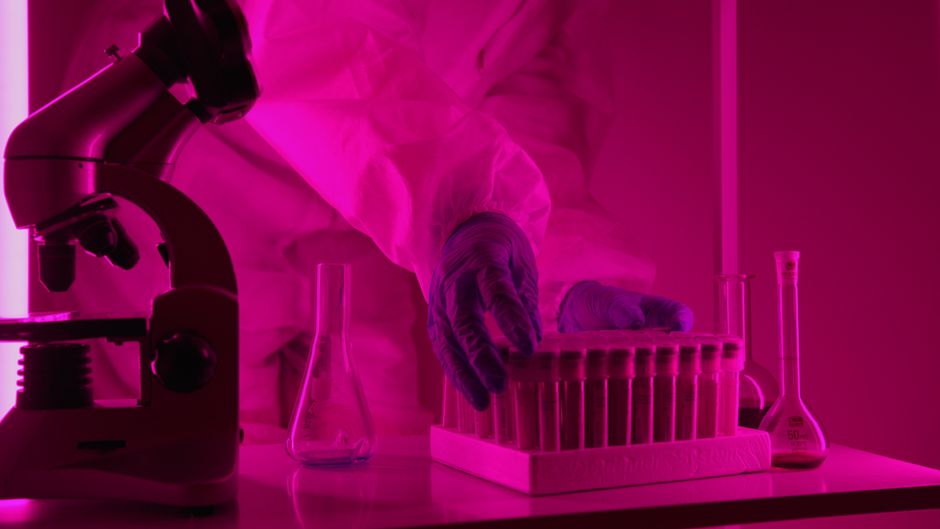
Self-driving laboratories join AI that chooses informative experiments, robotic instruments that carry them out, and scientists who set goals, safety limits, and meaning. The system repeats a closed loop: design, make, test, analyze, then choose again. It speeds disciplined search in chemistry and materials science, but it does not remove human judgment from research.
How are robots used to perform scientific research today?
Robots perform repeatable physical work: moving samples, dispensing liquids, running prepared steps, loading instruments, and collecting measurements. That is laboratory automation. It follows a plan made in advance.
A self-driving system adds a decision layer above the hardware. The 2024 Chemical Reviews assessment describes two defining dimensions: automated, data-driven experiment selection in software and automated experimental execution in hardware. A robot without the first dimension is useful automation, not a self-driving laboratory.
The distinction matters when the search space is large. A materials team can vary composition, temperature, processing conditions, and measurement choices. A fixed sequence tests what the team already chose. An autonomous loop uses results from earlier runs to rank the next run.
| Part of the loop | What performs it | What changes after each run |
|---|---|---|
| Design | AI model with scientist-set goals and limits | The next candidate or measurement |
| Make | Robotic handling and synthesis instruments | The physical sample |
| Test | Characterization equipment | The measured properties |
| Analyze | Software, models, and human review | What the system knows and what it should test next |
The practical loop is easier to see in Ada, a modular self-driving laboratory described in Science Advances. Ada mixed an ink, spin-coated a substrate, thermally annealed the film, imaged and measured it, recorded its current-voltage curve, calculated pseudomobility, and returned that result to ChemOS and a Bayesian optimizer. The target was organic hole-transport materials relevant to perovskite solar cells and consumer electronics.
The machine does not discover without a frame. It searches the frame it receives.
What is a self-driving laboratory?
A self-driving laboratory is a closed experimental system in which algorithms select samples or measurements, automated equipment produces and characterizes them, and the new data feeds the next decision.
The National Institute of Standards and Technology defines autonomous laboratories around this feedback loop, with the aim of maximizing knowledge gained in each experimental iteration. In a fully autonomous arrangement, sample generation, handling, and characterization need little human interaction.
“Self-driving” does not mean every lab reaches the same level. The Chemical Reviews article places most published examples at Level 2 or Level 3, rather than a fully autonomous Level 5 laboratory. Some systems automate one task. Others connect several tasks. The difference is not a label. It is whether decisions and physical work pass cleanly from one stage to the next.
Compatibility sets the boundary. A planner cannot choose a reaction its reactors cannot run, a sample its robot cannot move, or a test its instruments cannot read. In a Science molecular-discovery platform, researchers excluded reactions that the available automation hardware could not safely execute. The system combined generative machine learning, property prediction, synthesis planning, liquid handling, batch reactors, HPLC, robotic arms, and automated characterization.
That platform measured absorption maximum, octanol-water partition coefficient, and photooxidative stability, then used those results to retrain models and select later work. Across three design-make-test-analyze iterations, it realized 294 unreported molecules in its exploration study. The result shows both the strength and the limit of the approach: a fast loop inside a carefully built machine boundary.
For readers weighing AI systems beyond the lab, the same division holds in human oversight and AI rules: a tool can act quickly without owning the final responsibility.
Can an AI decide which experiment to run next?
Yes. AI can select the next experiment when it has prior data, a defined objective, reliable measurements, and access to an automated workflow that can perform the choice.
NIST's Autonomous Methods program describes CAMEO as a closed-loop system in which AI determines the material experiment, performs it, and collects the data. A cycle can take seconds to tens of minutes. The system analyzes experimental and computational history, then targets measurements expected to be most informative.
This is not a coin toss dressed as intelligence. NIST reports that CAMEO incorporates X-ray-diffraction theory and phase-map physics. Its related ANDiE system delivered a five-fold acceleration in neutron-scattering characterization of magnetic-material order parameters. Domain knowledge narrows the field. Data ranks the choices within it.
AI selection also works across distance. A Science study used a cloud-based planner to coordinate robotic synthesis and in-line characterization across five laboratories worldwide. It searched more than 150,000 candidate organic laser-emitter materials, identified 21 materials with improved emission gain cross sections, and verified three in thin-film devices with best-in-class amplified-spontaneous-emission thresholds.
Still, the goal comes from people. In the molecular-discovery study, human involvement included setting and adjusting objectives, supplying materials, and fixing unrecoverable failures such as HPLC clogs. NIST also builds human-in-the-loop tools that show interpretable AI reasoning and let experts add domain knowledge.
Data quality is the hinge. A fast loop that reads a flawed instrument output will repeat a flawed decision more efficiently. Nature Reviews Materials warns that robust operation and treatment of epistemic and stochastic errors are necessary before AI can substantially affect materials research. It names reproducibility, reconfigurability, and interoperability as core design requirements.
Robots make the hands steady. AI makes the next choice. Scientists decide what counts as a good question.
Frequently Asked Questions
What parts of an experiment can lab robots automate?
Lab robots can automate sample handling, liquid dispensing, synthesis steps, processing, instrument loading, characterization, and digitized data capture when the equipment and workflow support them. In the Ada thin-film system, the workflow mixed ink, coated and annealed a substrate, measured the film, and sent the result back to the optimizer.
Will self-driving labs replace human scientists?
No. Human scientists define objectives, set boundaries, provide materials, address failures, and judge what results mean. A Science molecular-discovery platform still required people to adjust objectives and repair unrecoverable equipment failures, while Nature Reviews Materials warns that automation does not easily free humans from laboratory work.
How do automated labs make research more reproducible?
Automation can record protocols and capture data in a consistent digital form, reducing variation in repeated tasks. A 2024 Chemical Reviews article explains that this documentation supports repeatability, reproducibility, sharing, and the recording of null results, provided instruments, data, and workflows remain reliable.
Sources
- National Institute of Standards and Technology: Autonomous laboratories
- National Institute of Standards and Technology: Autonomous Methods
- Science Advances: Ada, a modular self-driving laboratory
- Science: Autonomous molecular discovery platform
- Science: Distributed robotic synthesis coordinated by AI
- American Chemical Society, Chemical Reviews: Self-driving laboratories
- Nature Reviews Materials: Autonomous experiments using active learning and AI