
Does Gene Therapy Have to Change All of a Person's DNA to Treat a Genetic Disorder?
No. Gene therapy does not need to change every cell, or every copy of DNA, to treat a genetic disorder. It needs to reach enough of the right cells to restore a missing function, replace faulty cells over time, or give corrected cells an advantage. The needed share ranges from under 10% in one immune disorder to 20% to 25% of bone-marrow stem cells for sickle-cell disease.
Does gene therapy have to change all of a person's DNA to treat a genetic disorder?
No. A treatment aims at the cells that drive the disease, not at rewriting the genome in every tissue.
This distinction is the whole map. A blood disorder can be addressed through blood-forming stem cells. A disease affecting the liver, muscle, or neurons requires delivery to its relevant tissue. The question is not, “Was every cell changed?” The question is, “Did enough useful cells gain the needed function?”
Frontiers in Genome Editing puts it plainly: the number of cells that need editing depends on both the disease and the therapeutic strategy. Corrected cells can have a growth or survival edge. A small starting group can then matter far more than its first percentage suggests.
For X-linked severe combined immunodeficiency, or SCID-X1, functional T-cell progenitors have a selective advantage over affected cells. The review reports that fewer than 10% functional hematopoietic stem and progenitor cells are predicted to rescue the phenotype. Other blood disorders need a far larger corrected fraction for full correction.
Correction is not an all-or-nothing contest. It is a threshold problem.
| Disease setting or approach | What sets the useful threshold | Reported benchmark |
|---|---|---|
| SCID-X1 | Functional T-cell progenitors gain a selective advantage. | Less than 10% functional hematopoietic stem and progenitor cells predicted to rescue the phenotype. |
| Sickle-cell disease | Corrected stem cells must make functionally normal red blood cells. | At least 20% to 25% of bone-marrow hematopoietic stem cells must be modified for a curative strategy. |
| Hematopoietic stem-cell gene therapy | Corrected stem cells engraft and maintain blood production. | Reported engraftment ranges from 25% to more than 90%. |
What happens to the cells that gene therapy does not fix?
They remain, unless corrected cells replace them or outcompete them in the disease-relevant tissue.
That is not a treatment failure by itself. In some disorders, the untreated cells continue to exist while the corrected cells supply enough working cells or gene product to change the outcome. In other disorders, too many untreated cells leave the disease process in place.
Sickle-cell disease shows the difference. According to Blood Advances, symptoms resolve after allogeneic transplant when 20% to 25% of bone-marrow hematopoietic stem cells are donor-derived, even though most stem cells remain from the recipient. Donor-derived red blood cells survive substantially longer than sickle red blood cells. They can therefore become the dominant cells in peripheral blood without replacing every stem cell.
The result comes from both number and lifespan. A corrected red blood cell that stays in circulation longer gains ground each day against a cell that does not.
This also explains why a percentage from one disease cannot be carried into another. Hemoglobinopathies and Hyper-IgM syndrome type 1 need substantially higher edited proportions than SCID-X1 for full correction, according to Frontiers in Genome Editing. The biology of the corrected cell sets the bar.
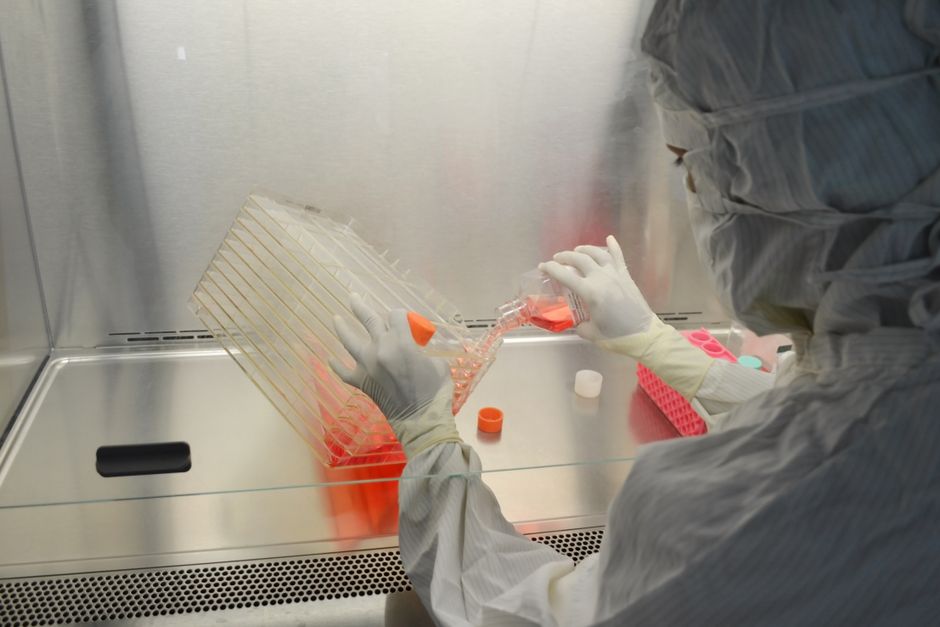
Ex vivo treatment makes that bar easier to measure before cells return to the body. Clinicians collect a defined population, introduce a transgene or edit outside the body, then readminister those cells. The approach commonly uses hematopoietic stem cells or T cells. It also confines manipulation to the selected cells, reducing off-target effects and bystander toxicity in other tissues, as the Frontiers review describes.
That defined boundary is one reason blood has become a central proving ground. The cells can be reached, changed, and returned.
Why can gene therapy work for blood disorders without editing every blood cell?
It can work because blood is continually renewed from a smaller pool of hematopoietic stem cells, and corrected descendants can supply the missing function over time.
Nature Portfolio's review of gene therapy describes hematopoietic stem-cell treatment as a sequence: take a patient's own stem cells out, correct them, and reinfuse them. Corrected stem cells can take lifelong residence in bone marrow and produce blood cells that had been deficient. The body does not need every blood cell altered on the treatment day if enough self-renewing stem cells establish themselves.
Blood has another advantage: its output is visible in the cells it makes. For sickle-cell disease, the cited 20% to 25% threshold refers to stem cells in bone marrow that are modified in a way that produces functionally normal red blood cells. It is not a claim that one quarter of every cell in the body must change.
In vivo therapy follows a different route. A vector is administered directly to a target tissue such as liver, muscle, or neurons. It avoids collecting cells and performing specialized external manipulation, as Wiener Klinische Wochenschrift explains. The price is delivery: the vector must reach enough of the right cells inside the body.
That price differs by organ. The same review identifies reaching enough cells for adequate modification as a challenge in central nervous system diseases. A target with accessible, renewable stem cells is not the same problem as a target spread through the nervous system.
Persistence differs too. Non-integrating vectors leave transferred DNA as an episome. It is not replicated during cell division, so expression can be lost as cells proliferate. Long-lived, nondividing cells can retain expression for long periods. Nature Portfolio also reports that AAV-based treatment durability can be limited by target-cell lifespan or an immune response to the transgene, and that antibodies after a first dose can neutralize later vector doses.
Delivery is one threshold. Durability is another.
Long follow-up reflects that reality. The U.S. Food and Drug Administration recommends up to 15 years of long-term follow-up for genome-editing products and integrating vectors such as lentiviral and gammaretroviral vectors. Its guidance recommends up to 5 years for AAV vectors, using a risk-based assessment of persistence, transgene expression, route of administration, and durability of clinical effect. A lasting change needs a long view.
For a wider foundation on inherited conditions, see How Are Genetic Conditions Passed Through Families?. The inherited change can be present throughout the body. A useful treatment does not need to be.
Frequently Asked Questions
What is the difference between in vivo and ex vivo gene therapy?
Ex vivo therapy removes selected patient cells, changes them outside the body, and returns them. In vivo therapy delivers a vector directly to a target tissue such as the liver, muscle, or neurons. The first approach confines the work to a defined cell set; the second avoids collecting and handling cells outside the body.
Can a gene therapy's effects wear off as treated cells are replaced?
Yes. A non-integrating vector can leave transferred DNA as an episome, which is not copied when cells divide. Expression can therefore fade as treated cells proliferate and are replaced, while long-lived nondividing cells can retain expression for long periods. Immune responses to the transgene can also limit durability.
Why are some organs harder to target with gene therapy than others?
The treatment must reach enough disease-relevant cells in the organ. The review in Wiener Klinische Wochenschrift identifies this as a challenge in central nervous system disease. Cell access, the number of cells reached, and whether target cells divide all shape the required delivery level and persistence.