
How Do I Identify an Old Camera and Estimate Its Resale Value?
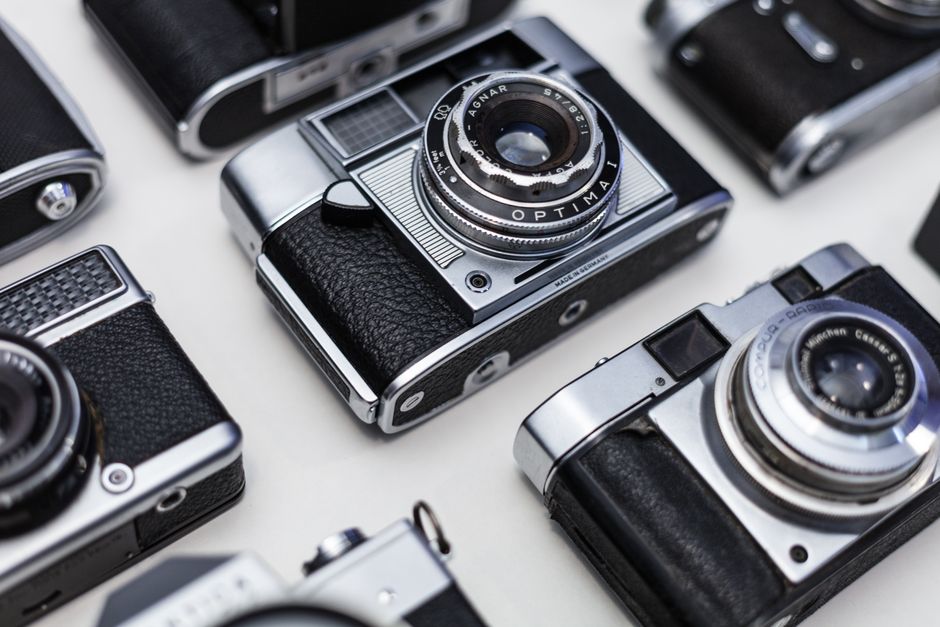
Identify an old camera by recording every marking on the body, lens, mount, and accessories, then locate its serial number without forcing any parts. Assess it in stages: inspect optics and corrosion, note whether controls operate, and describe faults plainly. Estimate value from completed sales for the exact model in comparable condition, not from active asking prices.
The useful sequence is simple: identify first, inspect second, price third. Reversing that order creates false confidence. A recognizable name on the front does not make an untested body equal to a working, serviced example.
How do I identify an old camera if I do not know the model?
Start by creating a photo-and-markings record before you clean, wind, open, or remove anything. The goal is not a dramatic restoration. The goal is a clear identity trail that lets you compare the right object with the right sold listings.
- Photograph the whole camera. Capture the front, back, top, bottom, both sides, open film-door area if it opens normally, and every included accessory.
- Capture the words and numbers. Photograph brand names, model names, lens inscriptions, mount markings, engraved numbers, country-of-origin labels, and markings on cases, flashes, caps, or boxes.
- Separate body from lens. A camera body and its lens can carry different model and serial information. Do not assume the lens name identifies the camera body.
- Record the mount and accessories. Photograph the rear of a lens only if it is already detached or can be removed normally. Do not force a stuck lens, battery door, winding lever, or compartment.
- Write down uncertainty. Use plain labels such as “model marking partly worn” or “lens remains attached.” That note is more useful than a guess.
Think of this as the evidence stack: every image narrows the search while protecting the item from unnecessary handling. The same basic discipline matters when evaluating other used purchases: evidence before conclusions, as in this site’s guide to ex-fleet cars.
Do not treat old film as a disposable accessory. The Library of Congress Preservation Directorate identifies cellulose nitrate negatives in the United States from 1889 to 1951 and says deteriorating nitrate and acetate materials can emit harmful gases. It advises individual buffered-paper sleeves for nitrate and acetate negatives because plastic enclosures can trap off-gassing and accelerate deterioration. If old negatives or glass plates are present, keep them separate from the camera sale decision until their material and condition are understood.
| What to record | Why it matters | What not to assume |
|---|---|---|
| Body name and markings | Establishes the starting model search | That a brand name alone identifies the model |
| Lens inscriptions and rear mount | Separates lens identity from body identity | That the lens is original to the body |
| Serial number | Supports manufacturer-specific identification | That every nearby code is a serial number |
| Case, flash, box, and caps | Documents what is included in the sale | That included accessories prove working condition |
| Film or negatives | May require separate handling and storage | That film should be opened, discarded, or stored in plastic |
Where can I find a camera's serial number and model name?
Look first at the bottom and back of the camera, then check the hot shoe, lens barrel, mount ring, and original box without confusing nearby codes for the serial number. Use the manufacturer’s location guidance as a map, not as permission to force a part loose.
Nikon Support says camera serial-number locations vary but are generally on the bottom or behind the camera. It also notes that box serial numbers are generally beneath the bar-coded label, while a Speedlight serial number is generally on the underside of the flash head. Take a sharply focused photo of the number rather than repeatedly handling the camera to transcribe it.
Manufacturer patterns can prevent a bad lookup. Canon Europe says EOS serial numbers are generally 12 digits, although some older EOS models have 6 or 10 digits. It says PowerShot and IXUS serial numbers are generally 12 digits, with some older models using 9 or 10 digits; it also warns that a company code can be mistaken for a lens serial number. For Canon cameras, check the bottom of the body or behind the LCD screen; Canon says lens serials can appear on the barrel or electronic mount.
Leica uses different locations by product line. Leica Camera USA states that Leica M1 through M10 camera serial numbers are on the hot shoe, and that M1 through M4 serial numbers are found there specifically. Leica also lists bottom-plate locations for several other camera lines, while Leica M-lens serial numbers are generally on the accessory ring and TL-lens numbers are on the mount ring.
The practical rule is match, then search. Search the brand plus the exact visible model text before adding a serial number. A serial number can help confirm details, but the model name, body shape, lens, and mount still need to agree with one another.
What should I test before selling a vintage film camera?
Before selling a vintage film camera, inspect and document its physical condition, test only controls that move normally, and state what was not tested rather than improvising a repair. The buyer needs a condition report, not an optimistic verdict.
Use a three-column condition note: observed, operated, unknown. “Observed” covers visible wear, corrosion, haze, fungus, or deteriorated foam. “Operated” covers functions that moved normally without force. “Unknown” covers anything you did not verify, including film results and meter accuracy. This reduces the buyer’s cognitive load because each claim has a boundary.
Camera Traders describes internal haze as a cloudy or foggy deposit, and fungus as specks, streaks, or web-like patterns. It says it does not buy lenses with fungus. The dealer also identifies sticky or crumbly foam around a film door as degraded light seals; replacement is possible, but labor and materials affect an offer. Photograph these issues in close-up rather than trying to scrape, dissolve, or clean them away.
For shutter and meter claims, keep the standard high. Camera Traders tests film-camera shutter speeds by machine and targets consistency within one-half stop of nominal speed. It tests meters with a calibrated light source at three intensities and targets readings within one-half stop. A hand-operated shutter that seems to fire is not the same as a measured shutter-speed result, and a meter needle that moves is not the same as a calibrated meter.
| Check | What to record | Listing language that stays accurate |
|---|---|---|
| Lens optics | Haze, specks, streaks, web-like patterns, marks | “Internal haze visible” or “fungus-like webbing visible; sold as-is” |
| Film-door foam | Sticky, crumbly, or intact material | “Light-seal foam is degraded” |
| Controls | What moved normally and what resisted movement | “Shutter releases at selected settings; timing not machine-tested” |
| Meter | Whether it responds; whether it was calibrated | “Meter responds; accuracy not verified” |
| Corrosion or damage | Location and extent shown in photos | “Corrosion visible in photographed area; functionality unknown” |
Use the condition report to choose the sales route. If the equipment is non-functional or damaged, parts-oriented language is appropriate: KEH Camera defines As Is equipment as non-functional or damaged and usable for parts. If the camera is popular and appears to be in good condition, a dealer may offer speed and inspection at a trade-off: Camera Traders says it offers about 70% of expected resale value for popular equipment in good condition, with the result varying by inspection and marketability.
For a private listing, price from evidence, not hope. CameraWorth reports that it counts completed sales, excludes live listings and unsold lots, and uses the median as its typical price with the middle 50% of results to reduce distortion from unusually high or low sales. Its clearest rule is the one to use: “On eBay only listings that sold count — never live listings or asking prices.” Compare your camera only with records that match the exact model and the closest available condition category.
Finish with a short listing drill. Write three lines before choosing a price: “Included: [body, lens, accessories].” “Observed condition: [visible issues].” “Testing boundary: [what was and was not verified].” Then compare completed sales again. If the price depends on a claim you cannot support, remove the claim, not the uncertainty.
Frequently Asked Questions
Are old cameras worth anything if they do not work?
They can be, but the listing must make the condition unmistakable. KEH defines its As Is category as non-functional or damaged equipment usable for parts, which is a useful model for honest descriptions. Identify the model, show the defect in photos, and avoid describing the camera as working unless it has been verified.
How do I find sold prices instead of misleading listing prices?
Use records of completed transactions rather than live listings or unsold lots. CameraWorth states that it counts completed sales and that, on eBay, only sold listings count, never asking prices. Compare the same camera model, then separate working, serviced, damaged, and parts-only examples before deciding what the results mean for yours.
Should I sell an old camera as-is, use a dealer, or list it on eBay?
Sell as-is when the camera is non-functional, damaged, or its operation is unknown and you can describe that clearly. A dealer can be useful when you want a structured inspection and a simpler sale; Camera Traders says its offers for popular equipment in good condition are about 70% of expected resale value, varying with inspection and marketability. A private marketplace can give you control over the listing, but it also requires precise photos, condition notes, and careful comparison with completed sales.
Sources
- Leica Camera USA: Serial Number Locations
- Nikon Support: Camera Serial Number Locations
- Library of Congress Preservation Directorate: Care, Handling and Storage of Photographs
- Canon Europe: Where to Find Your Serial Number
- Camera Traders: How We Test and Price Equipment
- KEH Camera: Grading System
- CameraWorth: Methodology